T-LESSA: Temporal-Logic Event Specification Steering of Video Diffusion Attention

Minkyu Choi1, Harsh Goel1, Soamar Homsi2, Sandeep Chinchali1
1The University of Texas at Austin, 2Air Force Research Laboratory
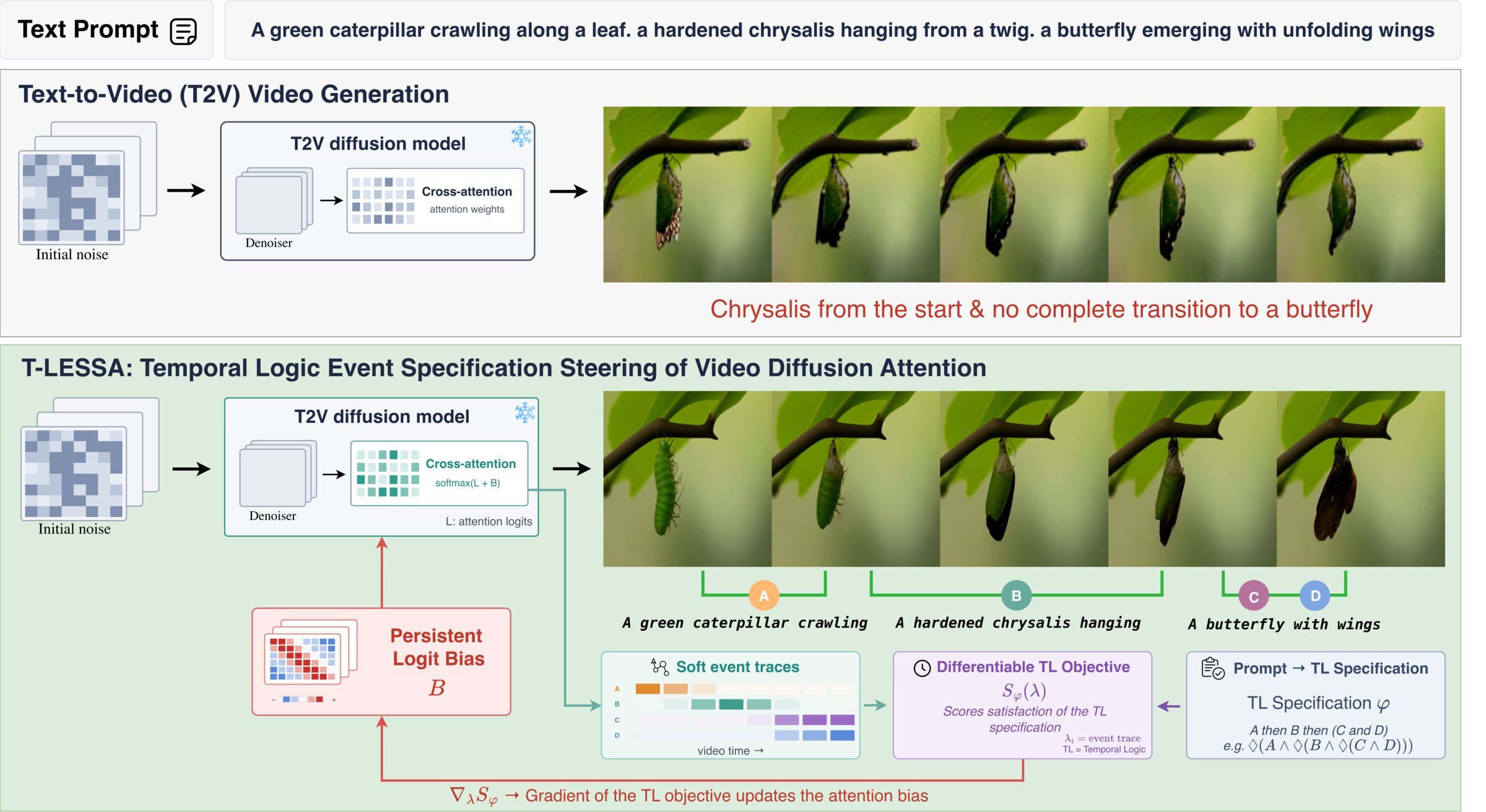
Overview of T-LESSA. Top: an unsteered text-to-video model, asked for a caterpillar, then a chrysalis, then a butterfly, starts with a chrysalis and never shows the butterfly. Bottom: T-LESSA turns the prompt into a temporal-logic specification, reads soft event traces from cross-attention, scores them with a differentiable temporal-logic objective, and feeds the gradient back as a persistent attention-logit bias; the video then shows all events in order.
T-LESSA steers video generation toward satisfying a temporal-logic specification. We ask for a caterpillar that becomes a chrysalis, after which a butterfly shows up with unfolded wings. Unsteered CogVideoX-5B starts with the chrysalis and misses the first and last events. T-LESSA first turns the prompt into the specification \(\Diamond(A \wedge \Diamond(B \wedge \Diamond(C \wedge D)))\), then guides each denoising step toward it, and the video shows all four events in the correct order.

Text-to-video models still miss events, merge them, or show them in the wrong order. T-LESSA writes the prompt as a temporal-logic specification and steers a frozen model's cross-attention toward satisfying it, with no training and no latent optimization.

+21.8%
TL satisfaction on TLVBench, averaged over four backbones
+14.3%
temporal completion
14 / 16
T2V-CompBench backbone–category pairs improved
1.7–13.5%
extra generation time

Gains are relative to the same backbone without steering.

Abstract

Recent advancements in generative video promise to transform challenging scenarios into training data: rare driving situations for autonomous vehicles, synthetic scenes for robot simulation, and realistic deepfakes for stress testing detection models. However, in practice, we still prompt a model and pray to get faithful videos. While a large body of research exists on generating good video, there is a lack of methods to enforce temporal and logical requirements (e.g., ordering, negation, co-occurrence) during video generation. Prior work has focused on fine-tuning with preference feedback or verifiable rewards. However, these methods require additional training and reduce a temporal-logic requirement to a scalar reward. This limitation has motivated a recent line of work that steers video generation at inference time without any training. Although these approaches control when each required event appears, they do not ensure that the generated videos align with their temporal and logical requirements. Therefore, we introduce T-LESSA, a training-free method that steers video generation toward satisfying a temporal-logic requirement. We show that T-LESSA improves temporal completion by 14.3% and, across four backbones, temporal-logic satisfaction by 21.8% over the unsteered baseline, at 1.7% to 13.5% additional generation time. Furthermore, T-LESSA improves compositional alignment in 14 of 16 backbone-category pairs on T2V-CompBench, and largely preserves video quality.
How T-LESSA Works

Temporal logic is the intermediate representation between the prompt and the denoiser. From it, T-LESSA builds a differentiable objective and applies its gradient to cross-attention at every steered denoising step.

Translate the prompt into a temporal-logic specification

An LLM agent splits the prompt into atomic events, assigns a proposition to each, and writes their temporal and logical relations as a finite-trace formula. A validation pass checks that every proposition is declared and grounded in a phrase of the prompt. For “A dog enters the room, and afterward the dog sits down. No cat appears,” the agent returns

$$\varphi = \Diamond\big(a \wedge \mathsf{X}\Diamond b\big) \wedge \Box\neg c,$$

with \(a\) = “a dog enters the room”, \(b\) = “the dog sits down” and \(c\) = “cat appears”.

Read a soft event trace from cross-attention

At denoising step \(i\), the attention mass that video tokens at temporal position \(t\) assign to the phrase of proposition \(\rho\) gives an event score in \([0,1]\), averaged over the selected heads \(\mathcal{C}\) and the \(N_s\) spatial tokens:

$$\lambda_{i,t,\rho} = \frac{1}{|\mathcal{C}|\,N_s}\sum_{r\in\mathcal{C}}\sum_{s=1}^{N_s}\sum_{j\in I_\rho}\alpha_{i,r,t,s,j}.$$

Score the trace with a differentiable TL objective

Each score is treated as a Bernoulli parameter. The specification's deterministic automaton runs over the time-unrolled trace, which gives a discrete-time Markov chain, and a bounded-reachability PCTL query asks how likely the chain is to end in an accepting state. Backward dynamic programming answers it exactly:

$$V_{i,T}(q)=\mathbf{1}\{q\in F_\varphi\},\qquad V_{i,t-1}(q)=\sum_{q'}P^{\varphi}_{i,t}(q,q')\,V_{i,t}(q'),\qquad S_\varphi(\lambda_i)=V_{i,0}(q^0_\varphi).$$

\(S_\varphi\) is the probability of satisfying \(\varphi\) under this attention-based model, not a calibrated probability that the rendered video satisfies it.

Steer attention with the gradient

The normalized gradient of \(S_\varphi\) accumulates in a persistent, bounded bias \(B\) that is added to the attention logits of each event's tokens at the next denoising step. Model weights and diffusion latents are never optimized.

$$\hat g_i=\frac{\nabla_{\lambda_i}S_\varphi(\lambda_i)}{\lVert\nabla_{\lambda_i}S_\varphi(\lambda_i)\rVert_\infty},\qquad B_{i+1}=\Pi_{\mathcal{B}}\big(B_i+\eta\,\hat g_i\big),\qquad \mathcal{B}=\{B:\lVert B\rVert_\infty\le b_{\max}\}.$$

By default we steer the first 40 of 50 denoising steps.

Agreement on binary traces. \(S_\varphi\) is multi-affine in the event scores, and on every binary trace it equals the classical finite-trace verdict: \(S_\varphi(\sigma) = \mathbf{1}\{\delta_\varphi^*(q^0_\varphi,\sigma)\in F_\varphi\}\). The continuous score therefore agrees with classical temporal-logic evaluation whenever events are fully present or absent.

TLVBench

We introduce TLVBench, a benchmark of 400 prompts that checks whether generated videos satisfy finite-trace temporal-logic specifications. Each prompt comes with its specification and the atomic propositions of its events, grounded as character spans in the prompt.

Logical · 100 prompts

NEG

\(\Diamond A \wedge \Box\neg B\) — the scene appears and the excluded object never does.
a man jogging down a city sidewalk past storefronts on a sunny morningA, without any carsB.
Logical · 100 prompts

CONJ

\(\Diamond A \wedge \Diamond B\) — both objects appear, often an unusual pair.
a cactusA. a trumpetB.
Temporal · 100 prompts

ORDER

\(\Diamond(A \wedge \Diamond(B \wedge \Diamond C))\) — three events in this order.
a deflated flat balloonA. a fully inflated round balloonB. torn rubber pieces of a popped balloonC.
Temporal-logical · 100 prompts

TEMPLOG

\(\Diamond(A \wedge \Diamond B) \wedge \Box\neg C\) — two events in order, and one object never appears.
a swimmer standing at the edge of a poolA, then the swimmer diving into the waterB. The video contains no gogglesC.

Every prompt starts with “A realistic high-quality cinematic video.”, omitted here. We also evaluate on StoryEval, TCBench, T2V-CompBench and VBench.

Video Comparisons

Every card uses one prompt and one seed for all methods. Colored phrases are the events of the specification, and a struck-through red phrase must never appear.

Against Inference-Time Guidance

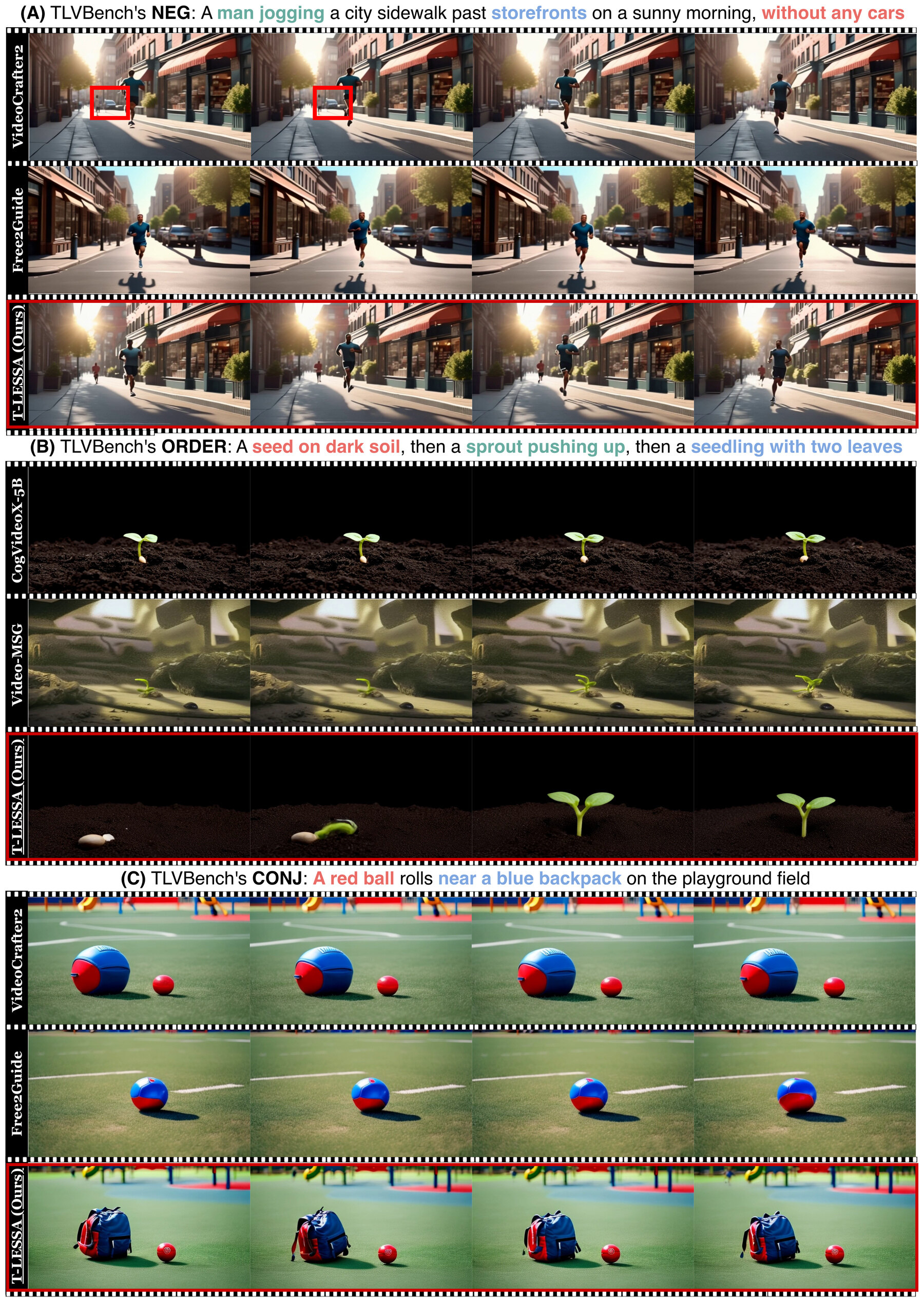
Frame strips for three TLVBench prompts. NEG: VideoCrafter2 and Free2Guide show cars that the prompt excludes, T-LESSA shows none. ORDER: CogVideoX-5B starts at the seedling and Video-MSG never shows a seed, while T-LESSA shows seed, sprout and seedling in order. CONJ: VideoCrafter2 and Free2Guide fail to draw a blue backpack, T-LESSA draws both the red ball and the blue backpack.
(A) NEG: VideoCrafter2 and Free2Guide generate cars although the prompt excludes them (red boxes); T-LESSA does not. (B) ORDER: CogVideoX-5B starts with the seedling and misses the first two events, and Video-MSG never begins with a seed; T-LESSA shows seed, sprout and two-leaf seedling in order. (C) CONJ: VideoCrafter2 draws a bluish ball instead of a blue backpack and Free2Guide gets neither object right; T-LESSA generates both.

Results

T-LESSA improves every class on every backbone

BackboneMethodNEGCONJORDERTEMPLOG
QI3NVQI3NVQI3NVQI3NV
Wan2.1-14BUnsteered.559.472.516.698.796.654.569.701.204.307.296.233
SwitchCraft––––––.670*.759*.212–––
T-LESSA (ours).652*.603*.630*.760*.874*.743*.622*.747*.214.421*.430*.313*
CogVideoX-5BUnsteered.542.433.498.244.411.216.256.478.137.197.319.235
Video-MSG–––.287.516.302.223.417.135–––
T-LESSA (ours).655*.578*.636*.350*.544*.320*.365*.566*.138.297*.440*.303*
VideoCrafter2Unsteered.452.410.312.370.498.230.190.346.133.139.286.167
Free2Guide.436.405.322.364.492.229.171.303.134.137.290.157
T-LESSA (ours).488*.457*.334.514*.672*.270*.266*.430*.139.188*.347*.175
AnimateDiffUnsteered.405.345.297.231.414.184.186.378.133.140.293.163
VideoGuide.412.391.304.259.399.182.180.367.135.133.279.166
T-LESSA (ours).435*.381*.303.297*.533*.203*.221*.440*.137.187.324.177

TL satisfaction on TLVBench, judged by Qwen2.5-VL-7B (Q), InternVL3-8B (I3) and NeuS-V (NV). * marks \(p<.05\) against the unsteered backbone (Wilcoxon signed-rank test on prompt means over three seeds). SwitchCraft needs an ordered list of events, and Video-MSG's planner cannot state that an object is absent, so neither applies to NEG or TEMPLOG. NeuS-V barely moves on ORDER because nested eventualities can be satisfied by a single frame; the sequence metrics below measure ordering directly.

Wan2.1-14B
+19.7%
CogVideoX-5B
+32.1%
VideoCrafter2
+20.7%
AnimateDiff
+14.9%

Average relative gain in TL satisfaction over the unsteered backbone.

Events come out complete and in order

Wan2.1-14BCogVideoX-5B
MethodTC-ScoreTCRStoryEvalTC-ScoreTCRStoryEval
Unsteered.675.290.336.396.060.190
T-LESSA.728.360.368.489.140.240

Sequence completion: TC-Score and TCR from TCBench, and StoryEval's story-completion rate. TCR requires all four TCBench assertions to pass, so it penalizes correct events in the wrong order.

One objectTwo objects
ObjectiveAcc.Abs.Pres.Acc.StaticTemp.
None (unsteered)69.9459.7580.1338.6848.0530.16
TempoControl83.3182.2584.3855.5262.8048.89
T-LESSA87.2593.5081.0048.0862.9334.59
T-LESSA + TC reg.82.7581.8883.6355.9268.5444.46

TempoControl's latent-steering setup with only the objective replaced. The TL objective also steers latents; TC reg. adds TempoControl's visibility and entropy terms.

TL guidance also helps general compositional alignment

Wan2.1-14BCogVideoX-5BAnimateDiffVideoCrafter2
CategoryUnsteeredSwitchCraftOursUnsteeredVideo-MSGOursUnsteeredVideoGuideOursUnsteeredFree2GuideOurs
Dynamic.0823.1072.0939.0146.0101.0335.0127.0094.0363.0122.0083.0303
Consistent.8220.8057.8190.7740.6332.7954.6740.6681.6769.7526.7908.7748
Action.7213.7241.7441.5317.3722.5654.4198.4126.4250.4822.5148.5380
Interaction.6950–.7113.5878.1969.6109.5574.5373.5067.6411.6794.6831

T2V-CompBench, official 200 prompts per category. SwitchCraft does not apply to Interaction, where every prompt describes a single event.

Video quality is largely preserved

MethodSubjectBackgr.AestheticImagingMotionDynamicFlickerTemp. styleObjectsSpatialOverall
Wan2.1-14B (unsteered).9305.9725.6423.6671.9668.7917.9822.2486.6471.8013.2665
T-LESSA (ours).9255.9726.6367.6583.9657.8056.9819.2489.7096.8377.2638
VideoCrafter2 (unsteered).9523.9819.6231.6548.9708.7500.9790.2631.5038.3554.2867
T-LESSA (ours).9332.9736.6092.6629.9538.8194.9719.2640.5213.4232.2861
CogVideoX-5B (unsteered).9487.9725.6028.6229.9774.4306.9724.2465.5488.5920.2573
T-LESSA (ours).9490.9734.5752.5725.9753.5278.9752.2395.6052.5087.2522

VBench, each dimension on its official prompt subset. T-LESSA raises Dynamic Degree and Multiple Objects on all three backbones, and the overall score drops by less than .006. Steering adds 1.7% generation time on Wan2.1-14B and 13.5% on CogVideoX-5B, with 2.96 and 0.19 GiB more peak memory.

BibTeX

@misc{choi2026tlessa,
  title  = {T-LESSA: Temporal-Logic Event Specification Steering of Video Diffusion Attention},
  author = {Choi, Minkyu and Goel, Harsh and Homsi, Soamar and Chinchali, Sandeep},
  year   = {2026},
  url    = {https://utaustin-swarmlab.github.io/tlessa/}
}

Acknowledgment

This work was supported by the Air Force Research Laboratory, Information and Spectrum Warfare Directorate (AFRL/RF). The views and conclusions contained in this document are those of the authors and should not be interpreted as representing the official policies, either expressed or implied, of the Air Force Research Laboratory or the U.S. Government.